

Hydro Highlight: Rio Bonham — Combining Tradition and Technology to Improve Flood Forecasting
Rio Bonham, a doctoral student in agricultural and biological engineering, is working to improve flood prediction by combining traditional engineering approaches with community-based knowledge systems. Originally from Madill, Oklahoma, Rio grew up on a small cattle operation where time outdoors fostered an early appreciation for natural systems. This experience shaped a desire to study water, a resource that lies at the intersection of agriculture, ecosystems, and human communities.
Research
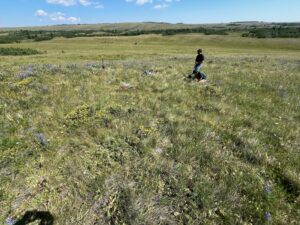
Rio Bonham soil sampling with a Montana State University/Piikani Lodge Health Institute study.
After graduating from Oklahoma State University with a degree in Biosystems Engineering, Rio moved to Gainesville to pursue a Ph.D. under advisor Dr. Rafael Muñoz-Carpena and deepen his understanding of hydrologic processes while improving predictive tools used to assess flood risk. Early in his doctoral journey, a mission trip to the Blackfeet Nation in northern Montana proved transformative. The experience highlighted both the beauty of the landscape and the profound relationship the Blackfeet people maintain with their environment.
“Too often, we as engineers leave people—especially Indigenous communities—out of our equations,” Rio explains. “When we do that, we miss a hugely important part of the systems we study, and we risk creating solutions that don’t actually help the people most affected.”
Working across disciplines and knowledge systems has also highlighted the importance of communication and shared understanding.
“I am always surprised by how much vocabulary can differ in trans-disciplinary work like mine,” Rio says. “I talk with folks in the Blackfeet community, hydrologists, AI scientists, and sociologists, and every one of them has different definitions of words I’ve never thought twice about before.”
Rio’s research focuses on developing a computational modeling framework capable of integrating both structured environmental data and unstructured knowledge sources, such as oral histories and archival documents. Through collaboration with Blackfeet Community College and the Medicine Spring Library, the project supports ongoing community efforts to digitize archival materials while also exploring how these sources can improve flood prediction models.

Rio Bonham with a local nonprofit (Piikani Lodge Health Institute) learning about hydrological considerations from cattle and bison producers on the Blackfeet Nation.
Why is This Important
Flooding regularly endangers lives and imposes economic hardship and displacement, particularly in rural and tribal regions where hydrological monitoring networks are often limited. These areas frequently lack dense records of streamflow, precipitation, and landscape characteristics needed to calibrate traditional hydrologic models. However, communities living in these regions often maintain detailed knowledge of local hydrologic behavior through stories, land-use practices, and historical observations passed down across generations.
Rio’s work aims to incorporate this knowledge into artificial intelligence–based hydrologic models using a hybrid, multimodal framework. This approach integrates structured environmental datasets, such as satellite observations and streamflow measurements, with qualitative data sources including oral histories and written archives. The goal is to improve flood prediction accuracy while ensuring that models better reflect the lived realities of communities most affected by flooding.
Beyond improving flood prediction, this research also contributes to broader conversations about how scientific and engineering disciplines can engage more meaningfully with community knowledge. By developing a reproducible framework that integrates Traditional Ecological Knowledge (TEK) into environmental modeling, Rio’s work demonstrates how diverse ways of understanding the environment can strengthen both scientific insight and real-world impact.
Life in Gainesville
Beyond research, Rio values the supportive academic environment within the Agricultural and Biological Engineering Department.
“My department (ABE) is wonderful to be part of,” Rio shares. “Fellow students, faculty, and staff are all doing exciting things, and they genuinely want to help you pursue your work as well.”
Outside of the lab, Rio and his wife have found a welcoming community at North Central Baptist Church in Gainesville, Florida, which has been an important source of encouragement throughout his doctoral journey.
Rio presented his research at the 2026 Water Institute Symposium, where he received a student poster award. Rio was also a recipient of the 2025 AGU Horton Student Award, a highly competitive national award given annually to up to three Ph.D. students studying hydrology, water resources, or closely related fields. The award recognizes and promotes excellence by investing in the next generation of leaders in the hydrological sciences. Rio’s research was subsequently spotlighted in an AGU newsletter.

Rio Bonham attending the 2026 Water Institute Symposium with his poster “TEK in Tech: Merging AI and Physics with Traditional Ecological Knowledge (TEK) for Flood Models on the Blackfeet Nation” and receiving a Student Poster Award.
This Hydro Highlight was created by the Water Institute Ambassadors Alexis Jackson and Lexi Bolger. Graduate students interested in being highlighted can fill out this survey to learn more.
April 28, 2026