

How Farmers, Foresters and Scientists Are Working to Protect Florida’s Groundwater
Gainesville, Florida (January 27, 2026) — Every growing season, farmers and foresters in North Florida’s Santa Fe River Basin make decisions that ripple across a landscape of row crops, pasture and pine plantations—lands that sit directly above one of the world’s largest and most productive groundwater resources. These decisions—about what to plant and how much to irrigate and fertilize—shape producers’ livelihoods and the future of the region’s water. Because different management approaches have their own costs and benefits, producers and policymakers need a clear understanding of the tradeoffs.
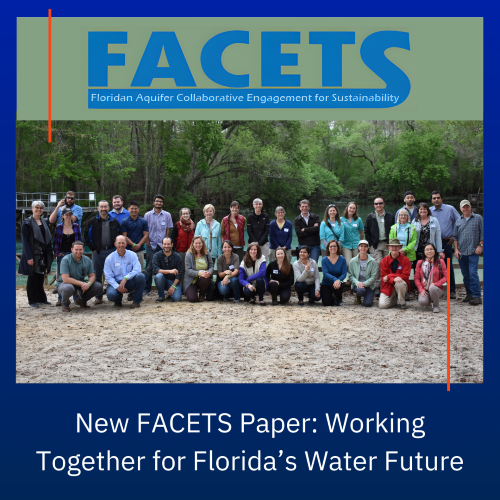
To help meet this need, an interdisciplinary team, facilitated by the University of Florida Water Institute, led a novel participatory modeling effort with local stakeholders, including producers, regulators and environmental organizations. Through the USDA-funded Floridan Aquifer Collaborative Engagement for Sustainability (FACETS) project, the team co-developed models of the environmental and economic tradeoffs of different land-use and land-management decisions being made at the scale of individual farm and forest parcels. Their findings, published in the “Journal of Environmental Management,” provide actionable insights for policy development that supports and incentivizes management practices to improve environmental outcomes without compromising economic and social sustainability.
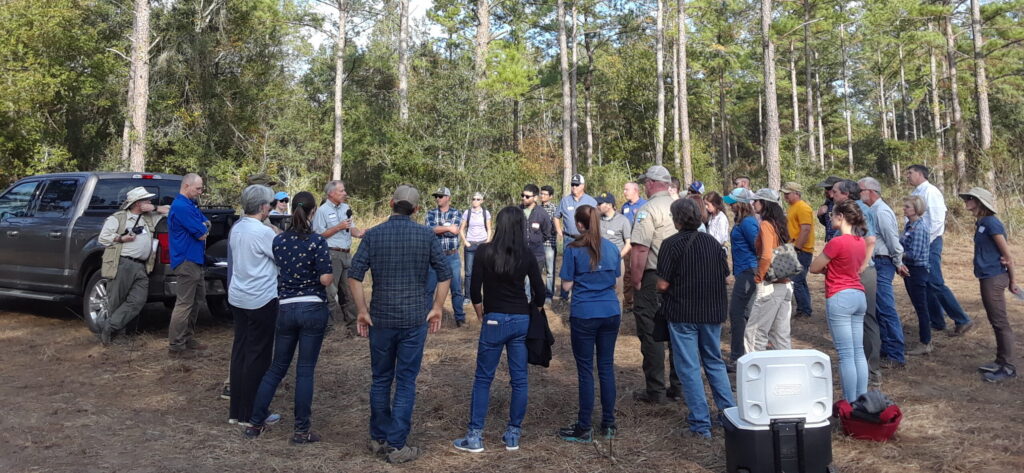
Critically, the participatory process deepened the understanding of on‑the‑ground agricultural and forestry practices for stakeholders and the project team, strengthening the model’s relevance.
In an anonymized exit survey with stakeholders from the FACETS project, participants reported gaining “a more comprehensive understanding of the impacts and interaction[s] that agriculture management [have] on water resources connected to the aquifer system” and noted that “[t]he modeling showed where we need to [go] to help improve and protect water quality.”
At the same time, members of the research team noted they “learned a lot about the complexities [of agricultural management] that [they] did not know before.”
The Santa Fe Basin sits atop the Upper Floridan Aquifer, a vital resource shared by Florida, Georgia and Alabama that is increasingly vulnerable to pollution and over-extraction. These growing pressures threaten food security, fiber production and vital ecosystem services that rely on the aquifer system. Recognizing how closely these systems are linked, the research team and stakeholders co-developed a coupled environmental and economic modeling framework, along with a set of realistic management scenarios, to evaluate environmental and economic outcomes.
Stakeholder involvement ensured the modeling reflected the real‑world constraints, decisions and opportunities that shape land‑management choices across the basin.
The modeling framework evaluated how different land-management practices affect groundwater quantity and quality, as well as producer profitability. The team examined major regional production systems—row crops, pasture and pine plantations—across a range of management intensities and identified several practices that reduce nitrate pollution and increase aquifer recharge while maintaining economically viable agriculture and forestry.
These win-win outcomes emerged only by considering environmental and economic tradeoffs together.
“Meeting river flow and water quality targets for the region remains a substantial challenge, but working with stakeholders helped clarify where changes in management practices can make a real difference — and highlighted where additional economic incentives will be essential to support adoption,” said David Kaplan, Ph.D., a professor in UF’s Engineering School of Sustainable Infrastructure and the Environment and lead author of the study.
Overall, the study demonstrates that improved agricultural and forestry management practices can play an important role in reaching water quality and quantity goals by enhancing groundwater recharge and reducing nitrate losses. But these outcomes are uneven across production systems and in some cases may not be economically viable.
“The power of this work came from weaving together different areas of expertise — crop science, hydrology, economics, along with the lived experience from producers. This interdisciplinary approach allowed us to see solutions that no single discipline or perspective could have uncovered,” said Wendy Graham, Ph.D., a professor in UF’s Agricultural and Biological Engineering Department and principal investigator of this USDA-NIFA sponsored project.
By bringing together stakeholder knowledge with state-of-the-art environmental and economic analysis, this work offers a practical, collaborative path for protecting groundwater while supporting working lands — not only in North Florida but in other groundwater-dependent agricultural regions facing similar challenges.
# # #
The article, “Stakeholder-informed environmental-economic tradeoffs at the farm and forest scale,” was written by David Kaplan, Kevin Athearn, Wendy-Lin Bartels, Paloma Carton de Grammont, Christa Court, Fei He, Robert Hochmuth, Unmesh Koirala, Dogil Lee, Joel Love, Nathan Reaver, Rob de Rooij, Kristen Rowles, Amanda Smith, Karen Schlatter and Wendy Graham. It will be free to access from the “Journal of Environmental Management” until Feb. 27.
ABOUT THE UF WATER INSTITUTE
The University of Florida’s Water Institute addresses complex water issues through innovative interdisciplinary research, education and public outreach programs. Its faculty share affiliations across twelve UF Colleges, including UF/IFAS, and study across a breadth of water-related topics.
waterinstitute.ufl.edu
ABOUT THE UF HERBERT WERTHEIM COLLEGE OF ENGINEERING
UF’s Herbert Wertheim College of Engineering is dedicated to cultivating the next generation of engineers and leaders who will drive technological innovation. The college is the second largest college and one of the top three research units at UF.