

Hydro Highlight: Fabian Quichimbo – Mapping the Hidden World of Water Beneath Our Feet
Growing up in Cuenca, Ecuador, Fabián Quichimbo was always fascinated by the source of its renowned clean water, which originates from mountain ecosystems called páramos. Curious about what makes it so pure and how it is distributed throughout the city, he pursued a bachelor’s in Civil Engineering at Escuela Superior Politécnica del Litoral (ESPOL) and a master’s in Hydrology at the University of Cuenca, both in Ecuador. Throughout his studies, his interest in the water cycle grew.
His research involved analyzing natural tracers, or chemical ‘fingerprints’, to understand water sources and movement. During this work, he also studied karst systems, which are geological formations formed by water dissolving rocks such as limestone that store water for 10% of the world’s population.
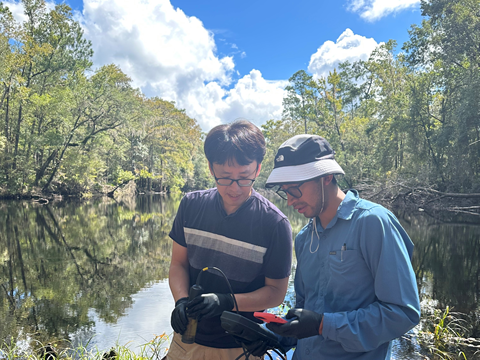
Quichimbo with his advisor, Dr. Seonkyoo Yoon conducting a dye tracer experiment.
What are Karst Systems?
This landscape type occurs where bedrock, usually limestone or dolomite, dissolves due to acidic water. Florida, built on limestone bedrock, has undergone this process as acidic rainwater gradually dissolved it, creating features such as sinkholes, tunnels, caves, and springs—collectively known as karst formations.
Research
Florida, with its numerous large springs and sinkholes, serves as an excellent natural laboratory for studying karst systems, which ultimately led Quichimbo to the University of Florida to pursue a PhD in Geological Science. As part of his dissertation research, he studies how groundwater moves, mixes, and reacts underground in these karst systems. As surface water enters the ground, it mixes with groundwater and interacts with limestone rocks through different pathways, where it undergoes numerous chemical and biological changes. These changes impact microbes that live underground, some of which can produce nitrous oxide, a powerful greenhouse gas that traps nearly 300 times more heat than carbon dioxide and contributes to ozone layer damage.
“To understand these systems and their internal interconnections, I use a holistic approach, a mix of tools including theoretical approaches, computer models, laboratory experiments, and fieldwork.”
– Fabián Quichimbo
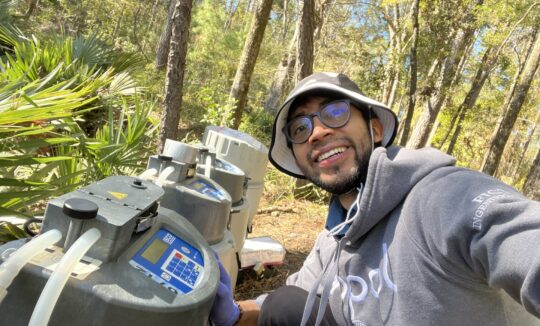 Quichimbo in O’leno State Park setting up water sampling experiment.
This approach enabled Quichimbo to work across disciplines, including hydrology, geology, and chemistry to understand karst systems and their multi-variable and interconnected chemical, biological, and hydrological processes. His technique involves using numerical models, laboratory experiments, and field studies to simulate groundwater flow in Florida’s underground karst systems. This approach helps track the movement of dissolved substances such as oxygen, carbon, and nutrients. By modeling different flow scenarios, Quichimbo enhances understanding of pollution transport and the microbial processes that generate greenhouse gases, which can help predict environmental impacts.
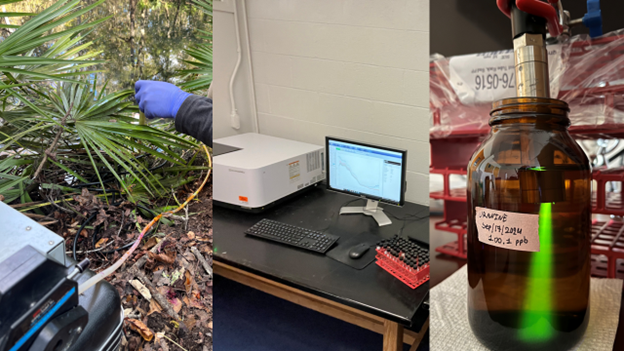 A set up of Quichimbo’s experiment (left to right): an uranine dye injection in the Sink–Rise system at Oleno State Park, Gainesville. The next image shows the laboratory work, where two methods were used: a spectrofluorophotometer and fluorometers (last panel) to analyze dye signals in standard water samples.
Why Does It Matter?
Groundwater, a vital yet hidden part of the water cycle, provides drinking water, supports agriculture, and sustains ecosystems, but it is vulnerable to human impacts like pollution and urbanization. As karst systems store drinking water for millions of people worldwide, including in Florida, understanding how water moves through these underground environments is extremely important. In certain areas, such as sinkholes, water flows directly from the surface into the ground, transporting anything on the land—whether beneficial or harmful—straight into the aquifer.
“With a clearer understanding of how water moves, mixes, and reacts underground, we can better manage karst aquifers, protect them from contamination, and prepare for how they might respond to changes in climate and land use.”
– Fabián Quichimbo
Sharing Knowledge and Building Connections
Quichimbo enjoys being a part of a large and growing community here in Gainesville that is achieving major scientific advancements and creating real impacts in society. Beyond his research, he enjoys engaging with K–12 students through science education programs. “I had the opportunity to give a talk to children about science in simple terms, and it was a great experience. Their curiosity is inspiring and refreshing,” Fabián recalls from his experience participating as an invited speaker in the Scientist in Every Florida School (SEFS) program.
Quichimbo will be presenting his research at the upcoming Water Institute Symposium.
“I am particularly interested in how AI, machine learning, big data, and convergent science can be integrated to enhance my research approach and improve the modeling of groundwater systems. I am also eager to learn how these tools can help anticipate future scenarios under changing climate and land-use conditions.”
– Fabián Quichimbo
This Hydro Highlight was created by the Water Institute Ambassadors Alexis Jackson and Lexi Bolger. Graduate students interested in being highlighted can fill out this survey to learn more.
January 20, 2026