

Hydro Highlight: Adeyinka Ayodele — Improving Irrigation Practices through Communication
When Adeyinka Ayodele arrived at the University of Florida in January 2025, he brought with him years of experience in landscaping, agricultural education, and environmental stewardship. Originally from Nigeria, Ayodele’s path to water conservation research began not in a laboratory, but in the fields and gardens where he built his early career.
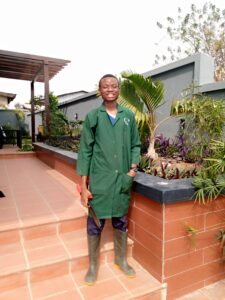
Adeyinka Ayodele doing Landscape work.
Ayodele’s passion for the environment began early. Trained first at Osun State College of Education (now University of Ilesa) with an associate’s degree in Agricultural Science, he continued to earn a bachelor’s degree in agricultural education from the University of Ibadan in 2022. His professional roles as agriculture science teacher, a farm manager, and project supervisor strengthened his commitment to creating landscapes that are both beautiful and sustainable.
His interest in landscaping eventually expanded into landscape architecture and environmental horticulture, where he encountered a challenge that changed his academic trajectory. While working with a client who had concerns about irrigation and water use, Ayodele realized he did not have the answers he needed. Determined to help his client, he began searching for water conservation research—where he discovered publications by Dr. Laura Warner, a professor of Extension education at UF who later became his graduate advisor. That moment sparked his move to Florida and his dedication to understanding water conservation behaviors.
Research
Ayodele studies the intersection of water conservation, behavior change, and science communication, with a focus on improving how Florida residents understand and follow lawn irrigation rules. His work addresses a critical issue: Florida faces increasing water scarcity, and lawn irrigation remains one of the state’s largest uses of residential water.
“If we are to conserve water, we need to address irrigation practices.”
– Adeyinka Ayodele
His previous research explores message framing, a communication strategy that emphasizes specific values—such as landscape aesthetics, environmental protection, financial savings, or community approval—to motivate homeowners to adopt more responsible water behaviors. Values are widely shared in cultural ideas that guide our choices and behaviors, such as responsibility, fairness, or compassion.
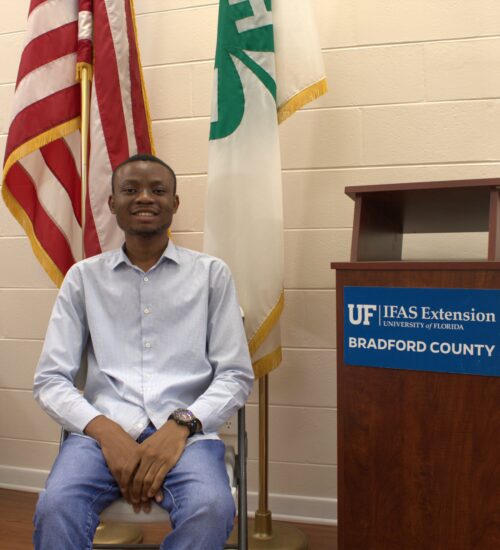
Ayodele at an UF/IFAS Extension office meeting with Bradford County Extension agents for his video project.
Ayodele’s recent findings reveal that a single exposure to framed messages is not enough to significantly change awareness or behavior. Only about 54% of surveyed residents were even aware that irrigation restrictions exist. Instead, residents’ adherence to local irrigation restrictions was more strongly influenced by factors such as how long residents had lived in Florida, whether information came from trusted sources such as Extension agents, utilities, or HOAs, or how credible residents perceived the messenger to be. These insights suggest that water conservation campaigns must move beyond one-time messages and toward repeated, tailored communication delivered through trusted, community-based channels like UF/IFAS Extension.
He is building upon the formative audience research findings by UF/IFAS PIE Center for his master’s thesis by applying behavioral science and creating and testing a series of videos with Hernando County residents on irrigation practices featuring UF/IFAS Extension agents that center around varying environmental messages, visuals, and values. Part of the motivation behind this is to correct misconceptions around irrigation and motivate real water conservation practices through different designs of value-based video messages. After the residents watch the prototype videos, Ayodele will interview them to compare and explain which messages were most compelling and effective in motivating change. These insights will guide the next phase, where the strongest messages will be shared on social media for broader testing.
Why This Matters
At the heart of Ayodele’s work is a commitment to bridging science and everyday life. He hopes to equip extension agents, utilities, and local governments with value-based communication strategies that resonate with homeowners and support long-term conservation.
“Creating value-based messages that people can connect with will help communities use water more responsibly. That’s how we support lasting conservation.”
– Adeyinka Ayodele
By identifying which messages work, which don’t, and why, Ayodele aims to help Floridians better understand their role in protecting a limited and increasingly stressed water supply.
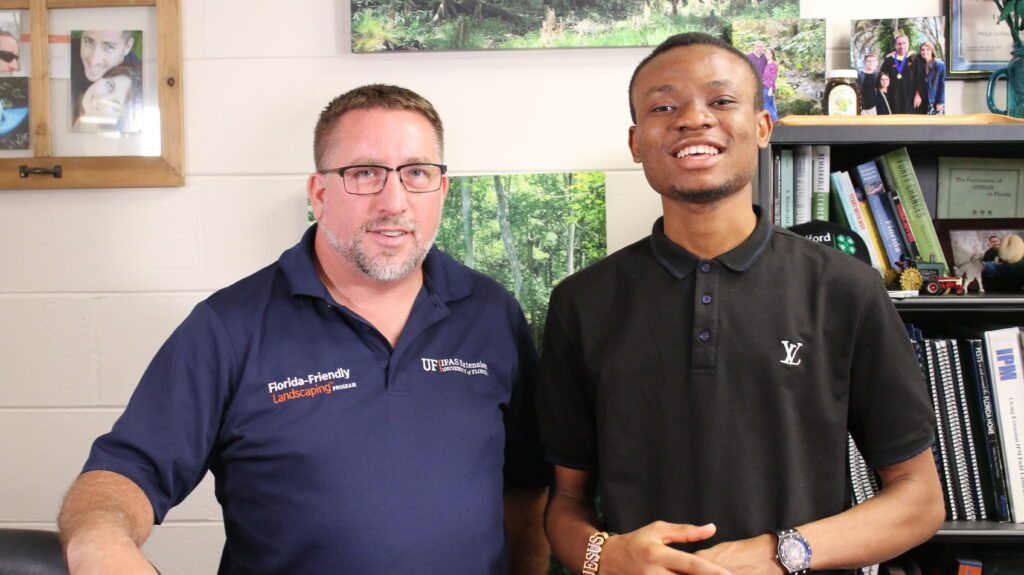
Ayodele with Luke Harlow, the UF/IFAS Bradford County Horticulture and Small Farms Extension Agent.
Sharing Knowledge and Building Connections
Adeyinka will be presenting his research at the upcoming Water Institute Symposium.
“I look forward to connecting with extension agents that are working in water conservation, water utility professionals and landscape professionals in Florida so I can learn from their expertise, collaborate with them, and help disseminate my research to a larger audience.”
– Adeyinka Ayodele
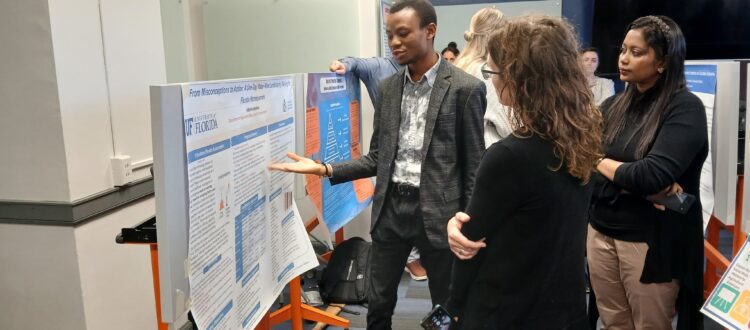
Ayodele presenting his research to his advisor, Dr. Laura Warner.
This Hydro Highlight was created by the Water Institute Ambassadors Alexis Jackson and Lexi Bolger. Graduate students interested in being highlighted can fill out this survey to learn more.
December 2, 2025