
From Soil Samples to Statewide Solutions: Water Institute Research Award Recipient Advancing Precision Irrigation
As Florida faces growing pressure on its water resources, Dr. Judyson Oliveira, a recent Ph.D. graduate of the Horticultural Sciences Department and now Research Assistant Scientist in UF/IFAS, is developing practical tools to help vegetable growers manage irrigation more precisely, conserve groundwater, and protect water quality. Oliveira received the 2024 Water Institute Research Award while completing his doctoral research. The award-supported work has since become a foundation for his broader research program in precision irrigation, water-table management, and irrigation automation.
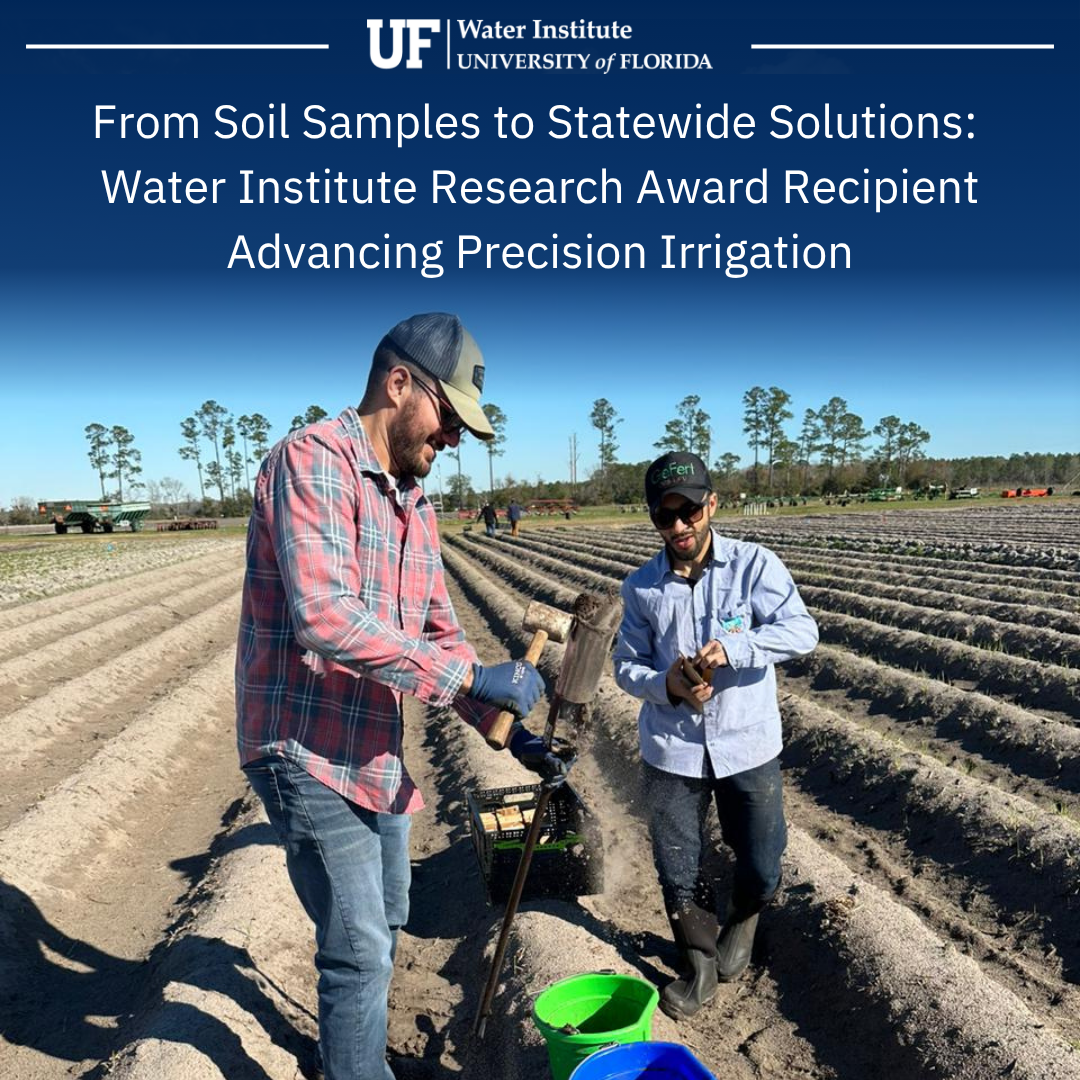
Developing site-specific irrigation recommendations generally requires measurements of soil physical and hydraulic properties, which can be time-consuming and expensive. Oliveira’s research evaluates whether these properties can be estimated from more readily available soil characteristics and used to recommend appropriate water-table targets for individual fields. With support from the 2024 Water Institute Research Award, Oliveira and his team collected approximately 180 soil samples from nine sites across seven vegetable farms. They analyzed soil texture and physical and hydraulic properties to establish the soil-water relationships needed to develop more site-specific subirrigation recommendations.
Site-specific recommendations are important because Florida’s sandy soils can behave differently from one farm to another. A water-table depth that works well in one field may be too shallow or too deep in another. Poorly matched targets can lead to crop water stress, waterlogging, excessive drainage, and nutrient movement off-site. Oliveira’s findings indicate that soil properties can provide a promising basis for improving site-specific water-table management in Florida vegetable systems. A manuscript reporting the findings is currently under peer review.
The Water Institute award helped Oliveira generate the data, technical foundation, and partnerships needed to expand his doctoral research into a broader applied research program. The award-supported work contributed to a successful project funded through the Florida Department of Agriculture and Consumer Services Specialty Crop Block Grant Program. Titled “Advancing Precision Irrigation for Specialty Crops: Development of a Statewide Tool for Site-Specific Subirrigation Recommendations,” the project began in January 2026 and will continue through August 2028. Oliveira and his collaborators are developing a practical statewide tool to estimate site-specific water-table targets and irrigation and drainage schedules using soil properties, crop water demand, and weather conditions. The project is expected to reach more than 200 growers and improve irrigation management across approximately 15,000 acres of Florida specialty crop production.
Oliveira’s current research also addresses the next challenge: helping growers maintain recommended water-table targets efficiently under commercial field conditions. His ongoing work evaluates lower-cost technologies for automating conventional seepage irrigation and drainage structures. Previous research with automated subirrigation-drainage tile reduced irrigation water use by up to 45% and drainage losses by up to 41% while maintaining potato yield. Current projects are adapting automation concepts to systems that are more widely used and accessible to Florida growers, with the potential to reduce labor and pumping requirements, improve in-field water storage, and decrease nutrient losses.
“My goal is to make precision irrigation practical for growers,” said Oliveira. “By combining field data, automation, and irrigation decision-support tools, we can help Florida vegetable farms manage water tables more precisely, save water, reduce labor, protect water quality, and maintain productivity.”